Pharma and lab machines are bought for precision and repeatability more than for raw speed. This guide is for formulation units, supplement and herbal manufacturers, contract manufacturers and research labs. It describes five core machines, sets out the points to settle before buying, compares new with used, and lists what a supplier needs in order to quote properly.
Types of pharma and lab machines and what each is for
Tablet Press
A tablet press compresses powder or granules into tablets between punches inside a die. A single-punch press makes one tablet per stroke and suits labs, trials and small batches. A rotary press has many stations on a turning turret and is built for production. The punch and die set fixes the size and shape of the tablet, so each product may need its own tooling. Presses are also used for supplements and herbal tablets.
Capsule Filling
A capsule filling machine opens empty hard capsules, fills the body with powder, pellets or granules, and closes them again. Hand-operated fillers suit labs and very small batches. Semi-automatic and automatic machines suit larger batches. Choose capsules over tablets when the powder does not compress well, when you want to avoid a granulation step, or when your market prefers capsules.
Liquid Filling
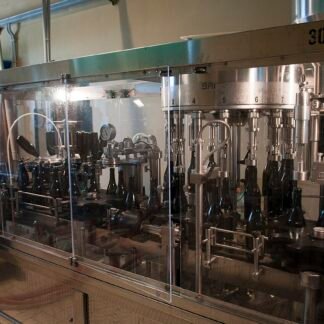
Liquid filling machines dose syrups, oral liquids, drops, lotions and lab reagents into bottles and vials. Small, accurate doses and clean contact parts matter more here than in general bottling. The pump or filling method is chosen by how thick the liquid is and how small the fill is. Decide the number of filling heads from your batch size, and ask whether capping is included or separate.
Bottle Washing
A bottle washing machine cleans bottles and vials before they are filled. Containers are held upside down and rinsed inside and out in a set sequence of water and air. Buy one when hand washing cannot keep up with the filler or cannot give the same result every time.
Strip Packing
A strip packing machine seals each tablet or capsule in its own pocket between two layers of heat-sealable foil. Unlike blister packing, no cavity is formed first, so the machine is simpler. The product is fully covered, which helps with items sensitive to light or moisture. Choose strip packing when you want a compact, enclosed pack and do not need the product to be visible.
How to choose
- Batch size and output: State your typical batch and how many batches you run in a week.
- Product behaviour: Does the powder flow freely or stick? Is the liquid thin, thick or foaming? Is the product sensitive to heat, moisture or light?
- Dose format: Tablet size and shape, capsule size, fill volume, bottle or vial size, strip layout.
- Change parts: List every size you will run. Tooling and change parts are a large part of the cost and decide how quickly you can switch products.
- Contact parts and cleaning: Ask what the product-contact parts are made of and how the machine is stripped for cleaning between products.
- Documentation: Decide which manuals, drawings and test records you need with the machine. Check the requirements that apply to your product and market, and tell the supplier at the start.
- Automation level: Manual and semi-automatic machines suit development work and short runs. Automatic machines suit repeated production.
- Power supply and utilities: Confirm the power available, and whether the machine needs compressed air, vacuum, treated water or dust extraction.
- Space: Check that the machine fits the room, the door and your material flow.
- Budget and operator skill: Presses and automatic fillers need trained setters. Count training and spares in the budget.
New or used
A new machine is the safer route for a new facility, or when your customers or the rules you work under call for full documentation from the maker. You get unused contact parts, tooling made for your product and, on MachineryInsider, a 12-month warranty. See the new pharma and lab machines available.
A used machine can be a sound choice for labs, pilot batches, supplement and herbal units, and for adding a second line at a lower outlay. Browse the used pharma and lab machines. The year and condition are confirmed on enquiry, and the buyer can inspect the machine before paying. Check the following:
- Trial under load: Run it with product or a placebo, not empty. On a press, check tablet weight and hardness across many tablets. On a filler, check fill accuracy.
- Wear parts: Turret, punches, dies and cams on a press. Dosing parts and capsule segments on a capsule filler. Pumps, nozzles and seals on a liquid filler. Sealing rollers and cutters on a strip packer.
- Previous use: Ask what products ran on it.
- Change parts: Confirm which tooling and size parts come with it, and whether more can be made.
- Electricals and safety: Panel, drives, sensors, guards and interlocks should all work, with nothing bypassed.
- Spares and support: Whether parts for that model are still obtainable.
- Paperwork: Manuals, the seller’s purchase invoice, and a written statement that there is no loan on the machine. A tax invoice is issued with your purchase.
Units with surplus equipment can sell a machine on the same platform.
What to send a supplier to get an accurate quote
- Machine type, and whether it is for lab, pilot or production use
- Product details: powder, granule, pellet or liquid, and how it behaves
- Tablet dimensions and shape, capsule sizes, or fill volumes and container sizes
- Batch size and output needed per hour or shift
- Contact part and documentation needs
- Power supply and utilities at your site
- Room dimensions and door size
- New or used, and delivery location
Send the list through the request a quote page. Prices are on request, and you will have a quote within 4 working hours.
Common mistakes to avoid
- Leaving tooling and change parts out when comparing two quotes.
- Buying a used machine without knowing what was made on it.
- Treating one machine as the whole line. A tablet press needs blending or granulation before it and packing after it.
- Assuming a machine meets your requirements because a seller says so. Verify it against the rules that apply to you.
Frequently asked questions
Which tablet press is best for small batches?
A single-punch press, or a small rotary press with few stations, suits small batches and development work. It uses little material and is quick to set up and clean.
What is the difference between strip packing and blister packing?
Strip packing seals the product between two foils that wrap around it. Blister packing first forms a cavity in a sheet, places the product in it and seals a lid on top. Strip packs enclose the product fully. Blister packs can show the product and are easy to push out one at a time.
Can one capsule filling machine handle different capsule sizes?
Yes, with change parts for each size. Ask which sizes are included in the quote, whether extra sets are available, and how long a size change takes.
Do I need a bottle washing machine for a small liquid filling line?
Not always. Very small batches are often washed by hand. A washer becomes worthwhile when washing slows the filler or when you need the same cleaning result on every bottle.
Summary
Define the dose, the batch and the documents first. The machine follows from those. MachineryInsider lists both new and used pharma and lab machines, and you can request a quote for any of them. Delivery is arranged worldwide. Remote installation support is included, with on-site installation on request.