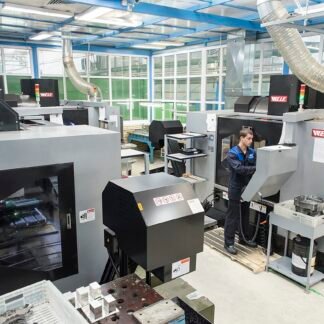
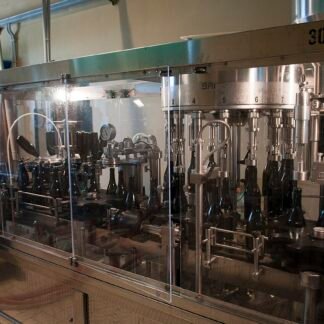
Holes, flat faces, slots and bores make up a large share of the work in any machine shop. This guide is for fabricators, tool rooms, maintenance teams and manufacturers about to buy a drilling, milling, boring or grinding machine. It explains what each machine is built to do, how to match one to your parts, where a used machine is a sound buy, and how to brief a supplier.
Types of drilling and milling machines and what each is for
Pillar drilling machine
A pillar drill has a fixed column, a table that can be raised or lowered, and a spindle fed down by hand lever or power feed. The part is moved under the spindle, so it suits small and medium work one person can position. Pick it when parts are light and you want the simplest way to make a hole.
Radial drilling machine
On a radial drill the drilling head travels along an arm that swings around the column. The spindle goes to the hole position while the workpiece stays clamped. This is the machine for heavy plates, frames, castings and fabricated structures. Choose it over a pillar drill once the job is too large or too heavy to slide around a table.
CNC milling machine
A CNC milling machine drives a rotating cutter along programmed paths on several axes. It produces flat faces, slots, pockets, contours and accurately positioned holes, often in one clamping. Pick it for moulds, dies, fixtures and batch components where the position of one feature relative to another matters. For plain holes in plate, a drilling machine costs far less.
Boring machine
A boring machine enlarges an existing hole and brings it to accurate size, roundness and alignment. Horizontal boring machines take large housings, gearbox cases and machine frames where several bores must line up. Choose one when the bore quality needed is beyond a drill or light mill, or the part is too big for a milling table.
Surface grinder
A surface grinder is a finishing machine. An abrasive wheel passes over work usually held on a magnetic chuck, leaving a flat, smooth surface to a closer tolerance than milling normally reaches. It is used on die plates, hardened parts and gauges, often after heat treatment. It works alongside a milling machine and does not replace it.
How to choose the right machine for your work
Work through these questions in order. Each answer removes options from the list.
- How big and heavy is the part? Table size, travel and load capacity must cover your largest regular job. For drilling, check the reach from column to spindle.
- What material are you cutting? Stainless, alloy steel, cast iron and hardened parts need more rigidity and spindle power than aluminium or mild steel.
- What accuracy do the drawings demand? Clearance holes for bolts are a drilling job. Dowel holes, bearing bores and ground faces need milling, boring or grinding.
- How many parts per batch? A few parts can be marked out and drilled by hand. Repeating batches justify CNC, jigs or both.
- Conventional or CNC? Manual machines cost less and are easier to keep running. CNC gives repeatability and complex shapes but needs programming.
- What power supply do you have? Confirm phase and available load. CNC controls are sensitive to voltage swings.
- How much floor space is free? A radial drill needs room for the arm to swing. A CNC mill needs space for its cabinet and coolant tank.
- Who will run it? Match the machine to the skill you have or can train.
- What is the full budget? Add vices, clamps, tool holders, cutters, grinding wheels, transport and installation.
New or used: when each makes sense
Buy new when accuracy is the reason for the purchase, as with a CNC mill for mould work or a grinder for finish-critical parts, and when the machine will be loaded every day. A new machine from MachineryInsider comes with a 12-month warranty. See the current new drilling and milling machines.
Buy used when the job is forgiving. Pillar and radial drills are simple, sturdy machines, and a sound older one handles everyday work well. Used CNC mills, boring machines and grinders can be good value but need a closer look. For used drilling and milling machines, year and condition are confirmed on enquiry and you may inspect before you pay. Points to check:
- Slideways and column. Look for scoring and uneven wear on table ways. On a radial drill, check that the arm clamps firmly and does not droop.
- Spindle. Inspect the taper for scoring, run all speeds and listen for bearing noise. Check the quill for side play.
- Backlash. Wind each axis back and forth and note the lost motion. On CNC machines ask about the ball screws.
- Performance under load. Drill, mill or grind a test piece in your own material. On a grinder, look for chatter marks.
- Electricals and controller. Test every function and limit switch, and confirm the CNC controller still has support and spares.
- Hydraulics and coolant. Look for leaks, especially on grinder table drives.
- Paperwork. Ask for the purchase invoice, confirm who owns the machine and whether a loan is outstanding against it.
Owners clearing floor space can also sell a machine on the marketplace.
What to send a supplier to get an accurate quote
- Part drawings, or the size and weight of your largest workpiece.
- Material grade and whether parts are hardened.
- Hole sizes, depths and tolerances, or the features to be milled, bored or ground.
- Batch quantity and how often the job repeats.
- Manual or CNC, new or used.
- Site power supply, delivery address and installation needs.
Submit these through the request a quote page. Prices are on request and quotes go out within 4 working hours.
Common mistakes to avoid
- Using a pillar drill for work that needs a radial drill.
- Expecting a drilling machine to hold bore tolerances that call for boring or reaming.
- Buying a CNC mill sized for the average part, then finding the largest part does not fit.
- Treating a surface grinder as a way to remove a lot of stock.
- Accepting a used CNC machine without seeing it run a program or checking ownership.
Frequently asked questions
What is the difference between a pillar drill and a radial drill?
With a pillar drill you move the part to the spindle. With a radial drill you move the spindle to the part by swinging the arm. Pillar drills suit smaller work; radial drills suit large and heavy work.
Can a milling machine be used for drilling?
Yes. A milling machine drills accurately positioned holes, and a CNC mill can drill, tap and bore in one setup. It costs more than a drilling machine, so it is not the economical choice for plain holes alone.
Is a used CNC milling machine worth buying?
It can be, provided the spindle, ball screws and controller are healthy and spares are available. Watch it cut a test part and confirm the paperwork before any money changes hands.
What does a surface grinder do that a milling machine cannot?
It produces flatter, smoother surfaces and copes with hardened material that is difficult to mill. It is the usual last operation on precision plates and tooling.
The right choice comes from the part: its size, the feature you need and the accuracy required. Browse new or used machines in this category, then request a quote with your drawings. MachineryInsider issues a tax invoice with every purchase, arranges delivery worldwide and includes remote installation support, with on-site installation on request.